The Time Total, an Achievement from the Treasure Trove of Film Art, as Not Just a Technical Principle, but as a Content-Related Principle
The Time Total, an Achievement from the Treasure Trove of Film Art, as Not Just a Technical Principle, but as a Content-Related Principle
The time total, an achievement from the treasure trove of film art, as not just a technical principle, but as a content-related principle / It then stands as a robust time displacement (images from foreign times appear in ours or encounter other foreign times, segments of a “spherical shape of time” are created) / This complements the principle of “similarities” (mimesis) that prevails in the picture atlas
The guest’s politeness responds to the exhibition space and thus opens up an indirect relationship to the picture atlas.
As already mentioned, Gerhard Wolf and I were guests in the NIOBE ROOM of the Uffizi Galleries with our installation concerning the picture atlas. Sculptures can be seen in this room. They show the sons and daughters of Niobe shortly before they die under the arrows of Apollo and Diana or already in death. The two aggressive deities, Apollo for rationality and Diana, his sister, for hunting, go wild. The same room also contains the Rubens painting “The Triumphal Entry of King Henry IV into Paris.”
Since we are already enjoying the hospitality of this room, it is a matter of courtesy to refer to this image too. With Wolf’s consent, I have therefore provided four films for this purpose:
- “The Unequal Eyes” / 3 min.
- St. Bartholomew’s Night / 9:44 min.
- The Death of the Good King / 3:29 min.
- The Triumphal Entry of King Henry IV into Paris / 3:39 min.
This has nothing directly to do with the picture atlas. However, a commentary effect is created because images from different times form a time total. This is a cinematic possibility that expands the principle of montage with the aid of A.I., the subjunctive of images, of images that already inhere in images and thus ignore unreal time difference and seek to restore the spherical shape of historical reality. This is nothing other than a lateral movement in relation to the picture atlas and a faithful continuation of elements from the panels.
The Rubens painting shows an INTROITUS, the traditional appearance of a new ruler (similar to the entry of Emperor Maximilian in Panel 57 in the picture atlas), and this occurs with the gesture of pathos that attends such an officially commissioned and paid for picture. Analytical perspective questions the images in detail and that is productive. Despite all the preoccupation with King Henri Quatre, it remains striking that there is no authentic picture of this ruler. Eenemies try to defame his image and followers try to adore (“worship”) him. He is southern French. Not typical of Paris. According to Le Corbusier, the fact that the king was short in stature meant that the rooms in the Louvre that he designed had a ceiling height for people of short stature and a human scale that was comfortable for Bauhaus taste. But one thing is certain: the king had unequal eyes. The one on the right was smaller than the one on the left. He saw everything, probably in two different ways. It is said that his vision was precise.
The massacre of the so-called St. Bartholomew’s Night, in which Protestants were slaughtered, took place the night before the wedding of this king to a princess from the French royal family. The fact that he escaped alive is one of France’s miracles. He then converted to Catholicism. His regime remained generous. Montaigne’s philosophy roughly corresponds to the mentality with which the king conducted politics and very short wars.
When the sans-culottes plundered the royal tombs in Saint Denis after 1789 and scattered the skeletons of the dead to the four winds, they carried the “good King Henri Quatre” to Paris and erected a monument to his sarcophagus on one of the bridges over the Seine.
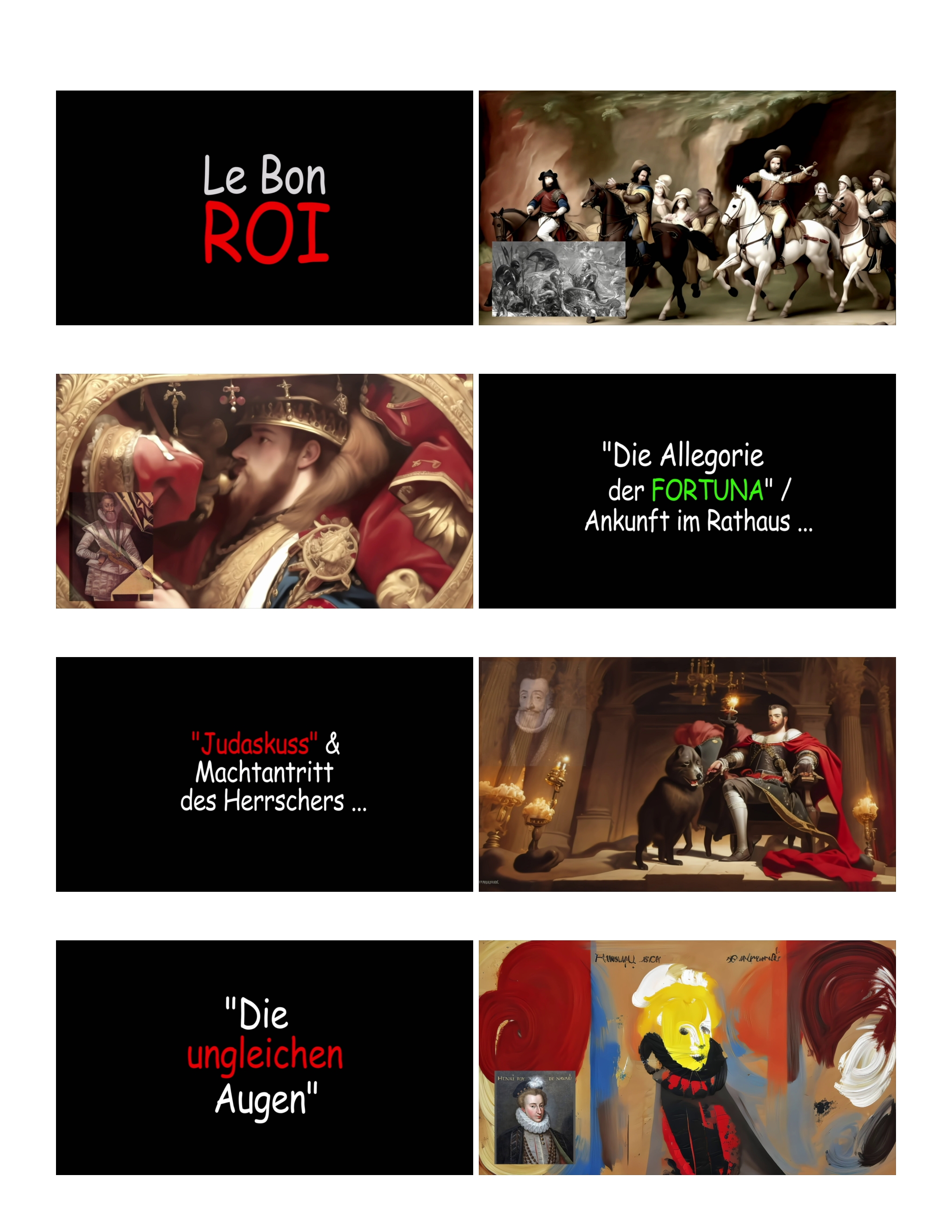
Excursus on King Henri Quatre
In 1610, this king had one of his decisive plans. He wanted to put an end to the nightmare of Spanish hegemony in Italy and Central Europe. This happened during the Eighty Years’ War between the Netherlands and Spain. The campaign seemed inevitable because an inheritance dispute in the provinces of Berg and Jülich-Cleve, two rich areas in northwest Germany, in which there was a conflict between a Catholic and a Protestant prince, would have destroyed all equilibrium. Allied with the Geusen of the Netherlands, Henri Quatre sought - in his own way - a quick decisive strike. The historian Herfried Münkler confirms that it would have removed all the reasons for the later Thirty Years’ War in six months. Twenty-nine years of civil, possibly even republican development would have been freed up. With long-term effect until 1933.
In a narrow alley in Paris in 1610, the king was stabbed to death in his carriage by a physically gigantic assassin, a fanatic of Spain. The assassin physically reaches through the window to the monarch’s chest. All protectors fail. I’m still sorry about that today.
We have to – with the means of film and also A.I. – release the images that deal with this from the shackles of then contemporary graphics. But we also have to “translate” them into our times and other times. This is how the “subjunctive of images” is created. It corresponds to the counter-algorithm to the “principle of fatality” – as if the reality of past events were a god. Iconographic and other observations, on the other hand, teach us: all reality is porous. Happy twists and turns exist in the gaps - like mole tunnels - and reality takes place only directly adjacent to them.
What is more or less described as “the flip side of history” cannot be represented with affirmative images. Counter-images are required, commentary, constellation and – as far as film is concerned – montage. Montage is nothing arbitrary or even “artistic,” but rather “reading reality as in sheep’s liver.” Parts of reality that are not directly visible but can be sensed and rendered intelligible become readable. This is the core point of the picture atlas.
- What does film art contribute to the ARCHAEOLOGY OF VISUAL EXPERIENCE?
- The Time Total, an Achievement from the Treasure Trove of Film Art, as Not Just a Technical Principle, but as a Content-Related Principle
- Luck / Fortune
Alexander Kluge: Cultural History in Dialogue is a joint project of Cornell University, Universität Bremen and Princeton University.