Luck / Fortune
Luck / Fortune
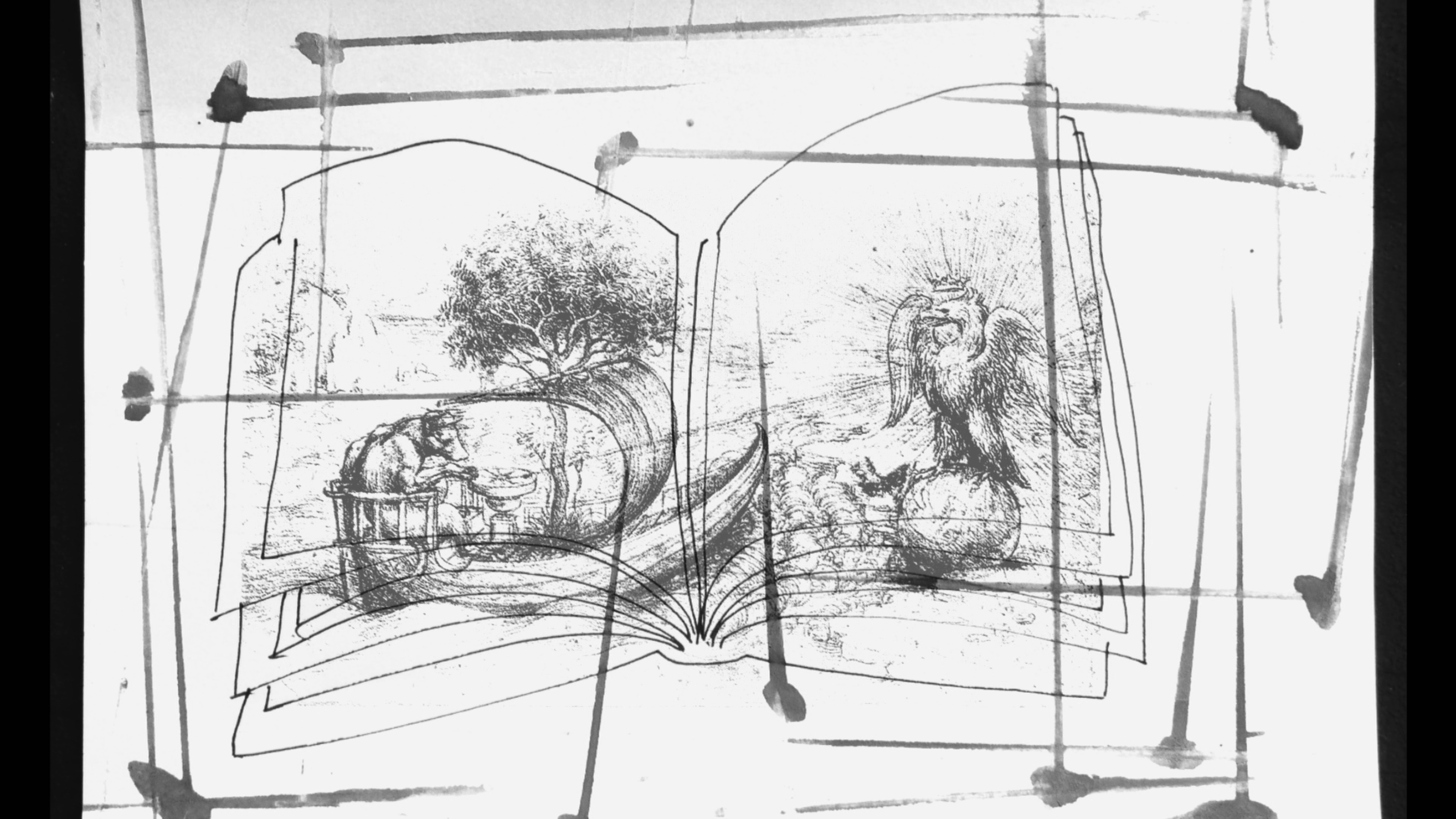
Film still from “Twice Fortuna.” For the Kluge/Thiede Collection, in Thomas Thiede and Alexander Kluge, *Dialogue (2017-2022)*, Distanz Verlag, 2023.
Allegory of Leonardo Da Vinci from the picture atlas. The allegorical wolf at the helm of a sailing ship is opposite the eagle holding the globe in its claws. The sailor’s mast is not dead wood, but a living tree in which the wind gets caught just as it does in the billowing sail. The allegory has a political subtext that is contemporary. Iconologically, the image is designated as “Fortuna.”
Emblems of Fortuna
In Warburg’s picture atlas (and more broadly in Benjamin and iconography in general) the idea of luck and its patron goddess is linked to the term “with a happy wind.” As sung about in Mozart’s Così fan tutte. Also by Rudolf Borchardt in “Manon,” Adorno’s favorite poem, which is included in my commentary film for Panel 57. The film “Fortuna with One foot on the Tiller” comments on another Fortuna emblem from the picture atlas. This figure stands on a sinking boat and has placed one foot on the rudder of the already sinking ship in order to “steer at the last moment.” From there to Tarot and the luck cards, the luck card and the death card, it’s not far. Mussolini hanging upside down in 1945, next to his lover Clara Petacci hanging at the same gas station, lead - not in the picture atlas, but in its necessary continuation - to the man hanging with his head towards the center of the earth on the tarot cards.
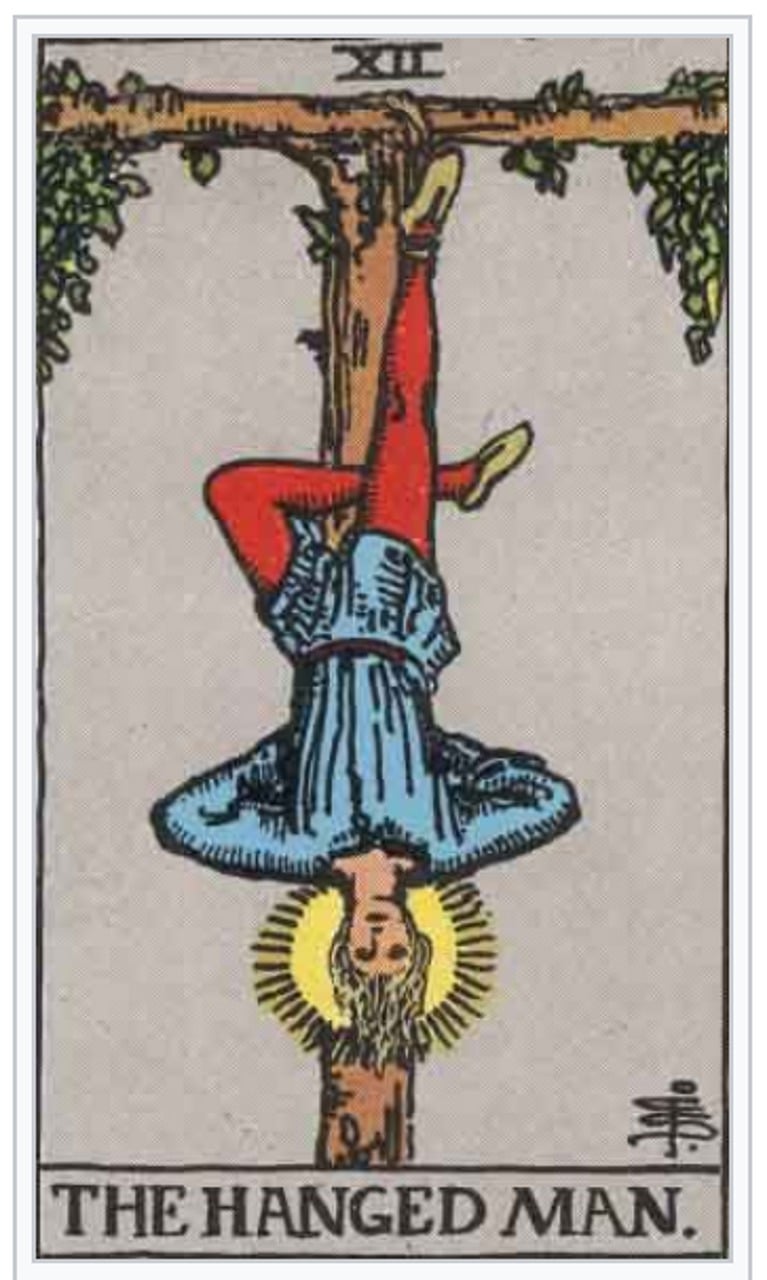
A completely different emblem, but one that denotes the same imbalances in the concept of happiness, is the “Wheel of Fortune,” which figures again and again in the Bilderatlas in various ways. The “thinking space,” the “dialectical image,” the “intermediate space” that links the images in the picture atlas, but also in the NARRATOR REALITY, current and possible images, imagination and reality, cannot be reproduced in language alone. But it’s not a matter of images alone either. In fact, we should look at every emblem, but also every current observation, through several linguistic and iconographic prisms. As the eye of a dragonfly does. Only then to summarize each perception again with the completely different focus of the eye of human narration. Only in such a “permanently working laboratory of experience” would one do justice to the picture atlas approach.
Isis Pelagia, the constellated medal in the picture atlas on the subject of Fortuna, alludes to the trip on the Nile of the popular adoptive emperor Hadrian. At his death, Castel Sant’Angelo in Rome, now part of the Vatican, was built as a tomb. He loved a young freedman more than his life. There was a conspiracy in the emperor’s entourage that killed the emperor’s favorite and weighted him down as a corpse at the bottom of the Nile. No matter how much the emperor searched, the dead man was never found. So the most powerful person in the empire was unable to protect what he loved most.
The medal’s theme is this fatalism of luck, the “powerlessness of the most powerful.” In the customary way, the medal uses a sail and Fortuna, as the operator of wind power, as its emblem.
Panel 70, Picture 8
Ship of Fortune / Rembrandt, 1634
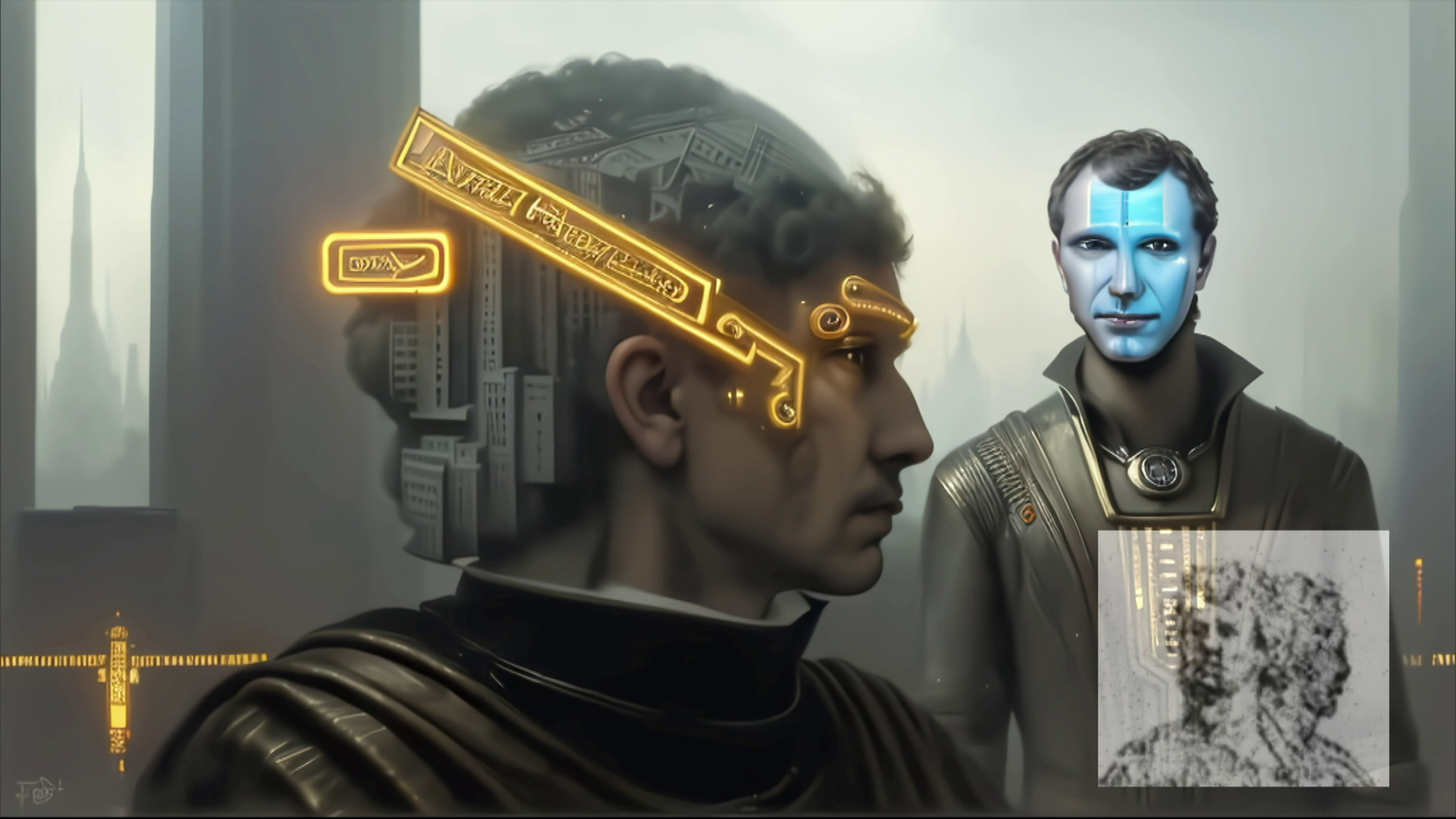
A Janus head can be seen in the original painting by Rembrandt. In the image above, the section from the original has been transposed using a virtual camera (A.I.). The image and the reduced original section at bottom right have the same template.
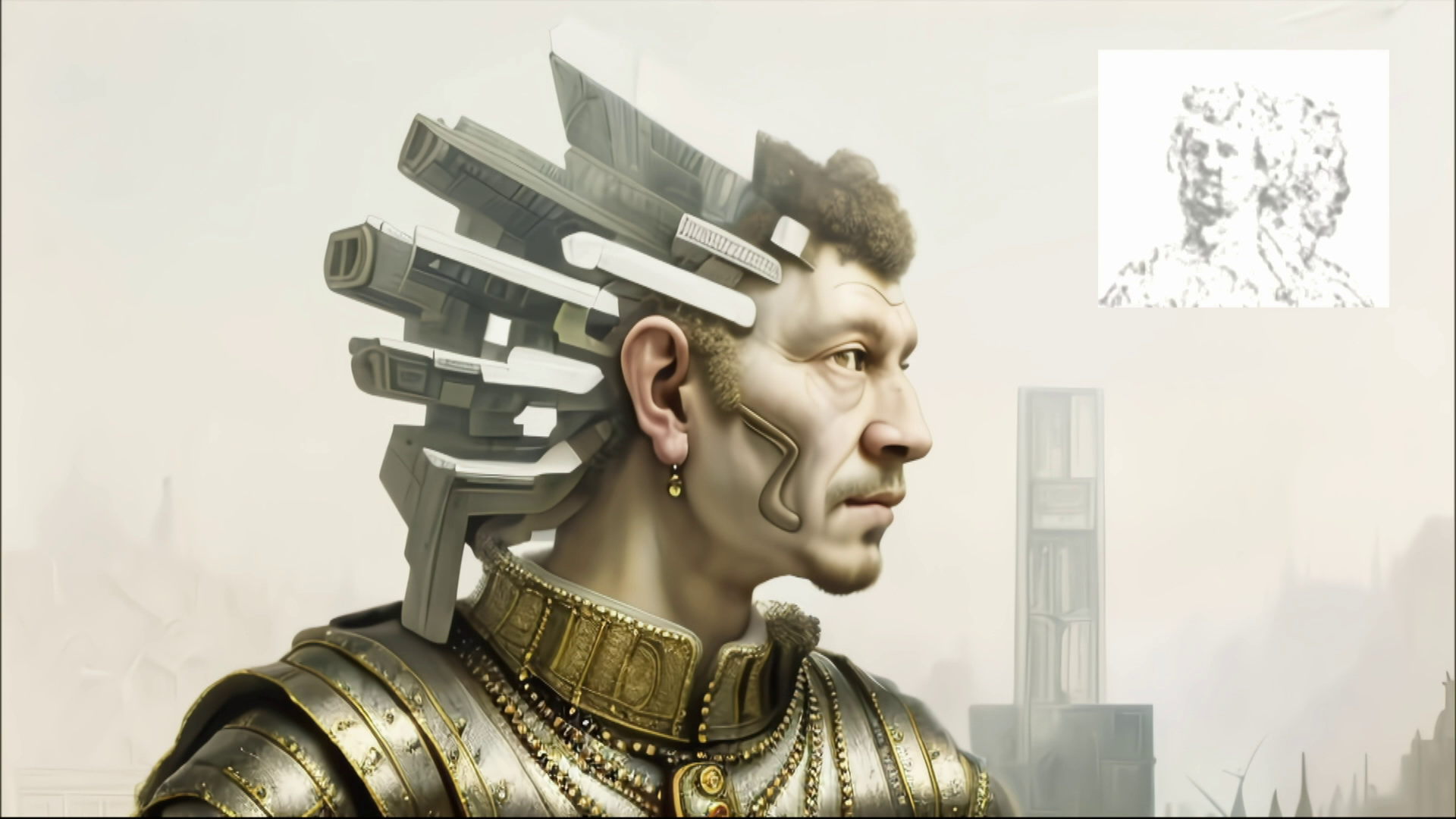
“Fortune like a dead horse”
Rembrandt constellates in his painting “The Ship of Fortune,” and Aby Warburg installs completely heterogeneous, initially unconnected emblems. “Fortuna like a dead horse.” The rider - according to Sigmund Freud, the ego that rides on a constantly moving horse, cannot steer it and yet is considered a rider - is referred back to what the ego is nonetheless capable of. “I know that I know nothing.” “I know how powerless I am, but I still keep moving.” A rider whose horse falls or lies fallen. Elsewhere in the picture atlas there is also a picture of a falling rider in a thunderstorm. On the left in Rembrandt’s larger picture, an apparently well established middle-class person has fallen with his horse. There is also the idiom of “happiness ridden to death.” A moment of happiness, seized by a human being, but ridden poorly by the rider.
The “digital Janus head.” As A.I. this device opens, like a raven, a dialogue with the future human being.
The traveling story of a young person looking into the future and an old man looking into the past has been common since Roman depictions by Seneca. In fact there is no subject who, on the basis of the root of his perception, sees into pasts and futures at the same time. The seer in Troy and his prescient daughter Cassandra report experiences to which the Trojans do not follow him. Just as a playing card in the Tarot can be a death card and a good luck card at the same time, just as the nymph - Ninfa in Italian - can be a messenger of death and an angel, which comes close to the true nature of angels according to Aby Warburg, only both sides of the opposition provide a reality.
With every newborn child a new light comes into realities. The Janus head is thus real and at the same time - according to Rembrandt - as unpredictable as happiness.
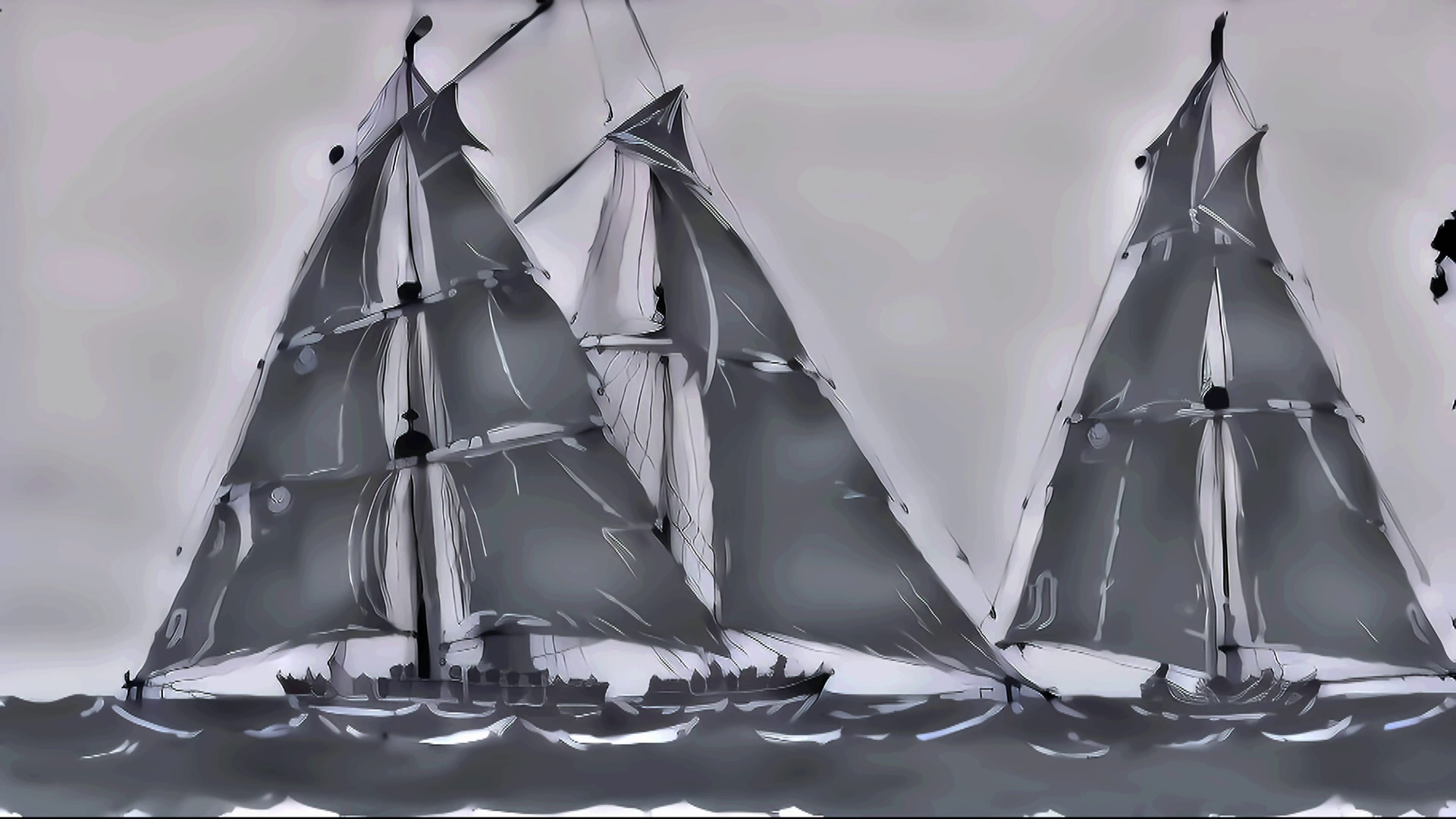
Black Sails
In antiquity, a returning fleet bearing the irretrievably dead sets black sails. The hero Theseus - he has just killed the Minotaur, he is prone to violence - sets BLACK SAILS when he returns home to Athens. His father, the king, seeing these sails, kills himself. This means that Theseus can inherit the throne immediately after returning home. Theseus, the Athenian confidant, is a “treacherous hero.”
Even what is dead is raped…
Worse than the murder of a living being is the erasure of its memory. Rembrandt’s picture brings together several forms of misfortune, anti-happiness (= the sabotage of a happiness that will not itself bring happiness), civil or business-related disaster, and aspects of the future. If human brains were ever equipped with A.I. aggregates and linked in such a way that the reflection of all previous human intelligence and its drives could erase or redirect some cruel aspects of its current application, SELF-REGULATION could result in a REPUBLIC OF THE HUMAN MIND that would modify the uncertain paths of happiness leading to disaster. FORTUNA RENATURATA. This is a rare pictorial event in iconography.
Alexander Kluge: Cultural History in Dialogue is a joint project of Cornell University, Universität Bremen and Princeton University.