Collecting what remains of collapsed relationality in the modern world… / The form for this is called COMMENTARY
Collecting what remains of collapsed relationality in the modern world… / The form for this is called COMMENTARY
On Panel C in Aby Warburg’s “Mnemosyne Atlas”
For tens of thousands of years, sailing ships used natural, but not always available wind power to move. A lull can decide naval battles. A storm can wreck proud fleets like the Spanish ones off and around Britain. Rich seafaring experience exists in the mind of Ulysses and, thousands of years later, in the minds of eighteenth-century captains. Then a hybrid development follows. A steam engine with a chimney is mounted on the hulls of sailing ships that still have sails. This makes them independent of the direction of the winds, allowing for record speeds for trade. But when the wind blows on the sails from astern, the sparks coming from the chimney ignite the forward sails. The hybrid phase in ship development was short.
In the same Panel C, attributes of the astronomer Johannes Kepler can be seen in the context of Zeppelins, aviation, constellations in the cosmos. It amazed me that the architecture of the steamships that followed the sailing steamships and the architecture of the Zeppelins continues in modern designs for spaceships. In itself, with weightlessness and a lack of air resistance in space, it would not be necessary to maintain these structures that apply to the Earth’s atmosphere. The iconology is conservative. The delicate, spider web-like “space rafts” or “cosmic vehicles” whose shape will one day determine space travel stretching over thousands of square kilometers – huge networks or areas –are currently inconceivable to us.
The panels from Aby Warburg’s picture atlas are cartographies of what we cannot imagine and what has already been expressed in terms of imagination. The contradictions are instructive, not the similarities between the images.
A soul mate for a thousand years…
After examining the signs of the zodiac, the astronomer and astrologer Johannes Kepler believed he was the reincarnation of the Roman Caesar Julian the Apostate. This emperor, who came to power after Emperor Constantine had proclaimed Christianity in Rome, was called “the heretic” = apostate because spiritually he could not endure the inflammatory destruction of antiquity by Christian bishops. He would rather renew the empire of Alexander the Great than allow himself to be subjugated through prayer. For Johannes Kepler, the claim that he was a soul mate of this emperor was not without danger. Soul kinship - in the sense of ancient theory, the insights of Sigmund Freud, and Aby Warburg’s overall concept - is an instantaneous event. The more than a thousand years that have since passed do not separate the Roman emperor, whose birth stars correspond exactly to those in Kepler’s horoscope, in any conceivable reality. It is as if the Roman emperor had just entered through the left door, Kepler is talking to his employer, Emperor Rudolf II, and explaining their kinship. In this way he faces his emperor “at eye level,” he as soul emperor, the other as installed emperor. As mentioned, such a position was not without danger for Johannes Kepler because Julian the Apostate was clearly a pagan. Kepler’s mother was accused of being a witch in a provincial town. Kepler managed to free her from her dungeon only by claiming imperial authority. The Spanish-controlled Inquisition in Central Europe was still intact.
Star kinship of souls is a largely unexplored area. This INTERDEPENDENCE OF ALL TIMES is captured better in iconography than in the rest of the public sphere. Constellations over thousands of years are something real. Any topicality that does not take this into account does not reference anything real. This is one of the strategic impulses of the “Mnemosyne Atlas.”
Panel 47 / Picture 13
Tobias and the Angel
Length: 01:06
The Book of Tobit is about the son of a pious Jew who had been kidnapped. As a child, this Tobit is sent out - in the German Bible tradition this son is given the name of the book Tobias, though his name is not Tobias but Tobit - to a city in Media. Three tasks from God await him. He is supposed to heal his blind father, he is supposed to marry a relative whose seven marriages have brought nothing but bad luck so far, and he has to defeat a demon so that this curse can be broken. He must also prove his piety through works. Like his father, he buries compatriots killed by tyrants, although this - similar to what happened to Antigone in Thebes - is forbidden on pain of death. But it is God’s command to commit a dead person to the earth with dignity.
Tobit, depicted as a wandering child, is led by a companion. This is the archangel Raphael, but Tobit doesn’t know this.
An enigmatic fish full of aggression and healing power …(“Heilkraft”)
Length: 01:21
As Tobit washes himself in a large stream, he is attacked by a fish. When this fish is killed, the angel advises him to burn its entrails. Using a tincture from the insides of the fish, Tobit later coats his blind father’s eyes and succeeds in making him see again. The antidote, obtained from the biting and probably poisonous fish, also drives away the demon that on every wedding night had killed the previous husbands of the young woman whom Tobit is supposed to marry and free. Latin and Greek teachers at my high school, who also taught Hebrew and came from the context of the Pforta school - the school where Friedrich Nietzsche was once a pupil - had the habit of saying, when one of us students yawned: Tobias 6, Verse 3.
Luther translates this as “O Lord, he wants to eat me.” This alludes to the gaping mouth of the apparently large predatory fish.
“Before his death, Tobias witnesses with satisfaction the fall of Nineveh, the City of Rages”
Length: 01:41
The images on Panel 47 dealing with the Book of Tobias take up a large amount of space. At the end of his life, Tobit witnesses “with satisfaction“ the fall of Nineveh, the city of the tyrant, who falls with it.
Return of Judith to Bethulia / Sandro Botticelli (1472)
“Her servant carrying the head of dead Holofernes”
Length: 01:39
Judith seeks out Holofernes, who is besieging Jerusalem, in his camp, makes him drunk and cuts off the head of the strong man, who sleeps as if he were unconscious after the night of lovemaking. In the picture atlas she is one of the women with a “drawn sword.” In the picture, her servant is carrying the (now smaller-looking) head of the dead Holofernes on her head. This is how the death of the tyrant is proven. This involves formulae for pathos. They are also called “dynamograms.” The range, the spectrum of pathos, extends from “Headhuntress” to “Guiding and Saving Angel.” For Aby Warburg and Walter Benjamin, pathos is not “concentrated impetus in one direction,” but rather a polyphonic network that spreads out around itself.
Georges Didi-Huberman calls the panels – and above all their overall relationality – “orientation boards for the exit from disaster.”
Panel 45 - Picture 6 / Jacopo and Tommaso Rodari (1491 – 1509) / Christ Offering in the Temple / With a Hercules Relief on the Altar
The moment in the life of the Son of God in which he is almost officially presented to God in the temple - “two doves are sacrificed” - the Offering of Christ is one of the original holidays. In the depiction of this significant hour, the relief of Hercules is shown below the Christ child, who is being held “as if in baptism.” The relief portraying the “victorious man of action.”
Hercules is present several times in Aby Warburg’s picture atlas. The demigod who fought with a snake in the cradle is a particularly puzzling iconological case. Unlike the mostly affirmative heroic stories handed down in literature, the images here show the “capacity to work,” the aggressiveness and ruthlessness of the “Herculean grip,” and the wanderings of this “pioneer of the working class” (Heiner Müller).
Panel 57 / Picture 8 / Albrecht Dürer 1498
Hercules and Virtue Fight the Vices (Jealousy)
This involves a picture by Albrecht Dürer. At the bottom left there are two figures, one of which is characterized as a devil. The “Emblem of Jealousy,” one of the sins that Hercules and the Emblem of Virtue fight together, is well protected by the devil or the “specter from ancient times with horns on his head.” Both the Emblem of Virtue and Hercules have long staffs for striking. The tree trunk that Hercules uses to strike still has roots on its underside.
The characteristics of Hercules in the picture atlas are different. The deeds of Hercules, as the Renaissance received them from antiquity, contain “works.” In the twentieth century, the workers’ movement - and the playwright Heiner Müller explained this in detail - recognized the concept of labor power in the figure of Hercules. The image of the “total worker” (Marx) at the world exhibitions in Paris in 1937 and in New York in 1939 is linked to the iconography of Heracles. However, all the “work” and “works” that Heracles performs are carried out in service to someone else, for a royal tyrant who, with his orders, wants to destroy the hero Heracles or at least remove him from the hero’s sphere of influence. All of the hero’s work is soaked in poison, as is the garment that burns his skin with poison at the end of his life. He can no longer bear being in his skin, gives up his immortality, and allows himself to be burned at the stake.
On the one hand, he cleans the Augean stables using robust precautions, so he seems to be resolute and productive. On the other hand, he is characterized by aggressiveness and also a large amount of brutality and ruthlessness. If one analyzes the entire message of the iconology of Heracles, what emerges is a monster, hardly a “liberator.” From the prints of the Dutch printer Goltzius to the depictions in the picture atlas, the emblems of Hercules alternate between determination and ambivalence.
Panel 38
Preliminary remark
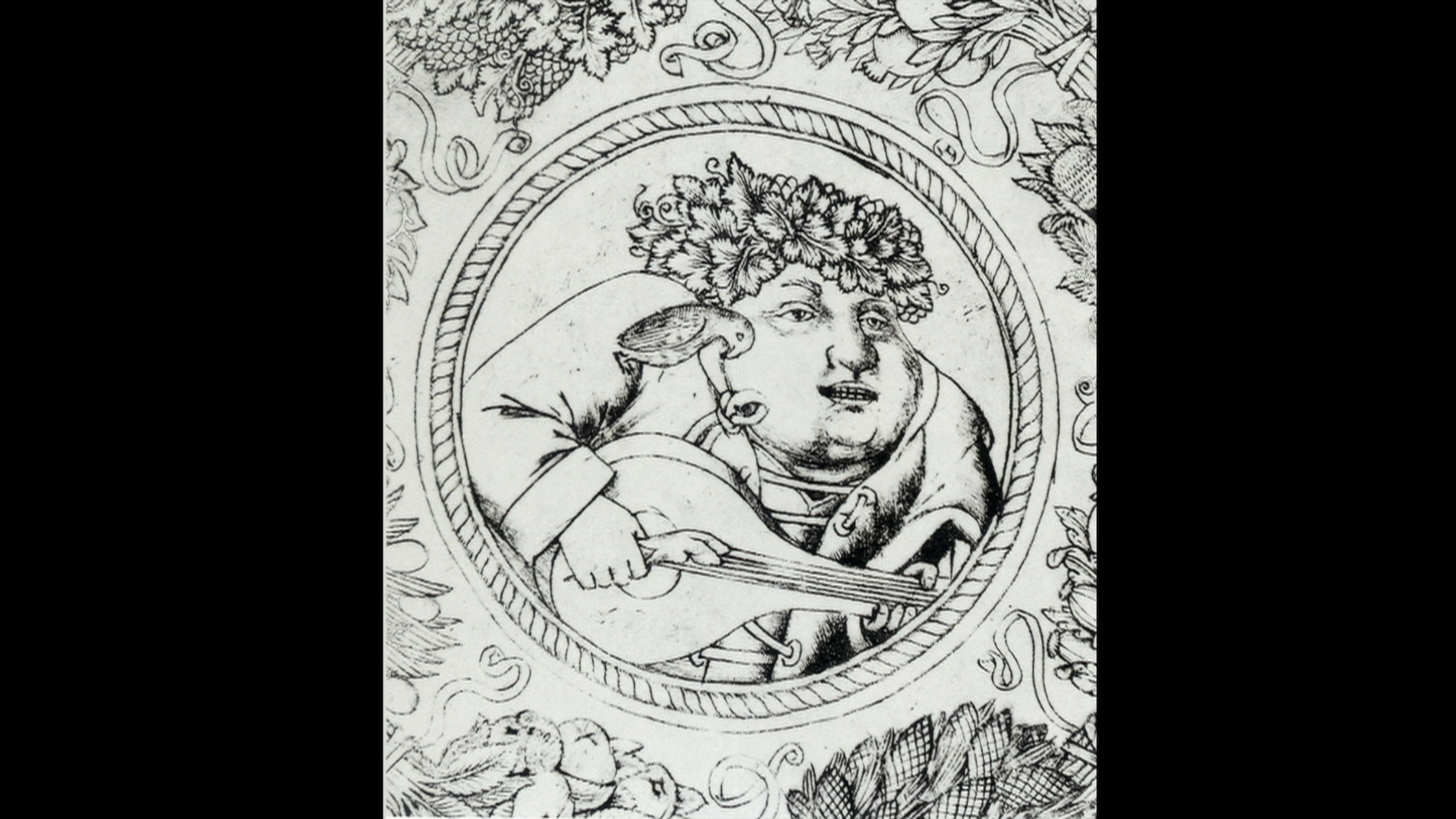
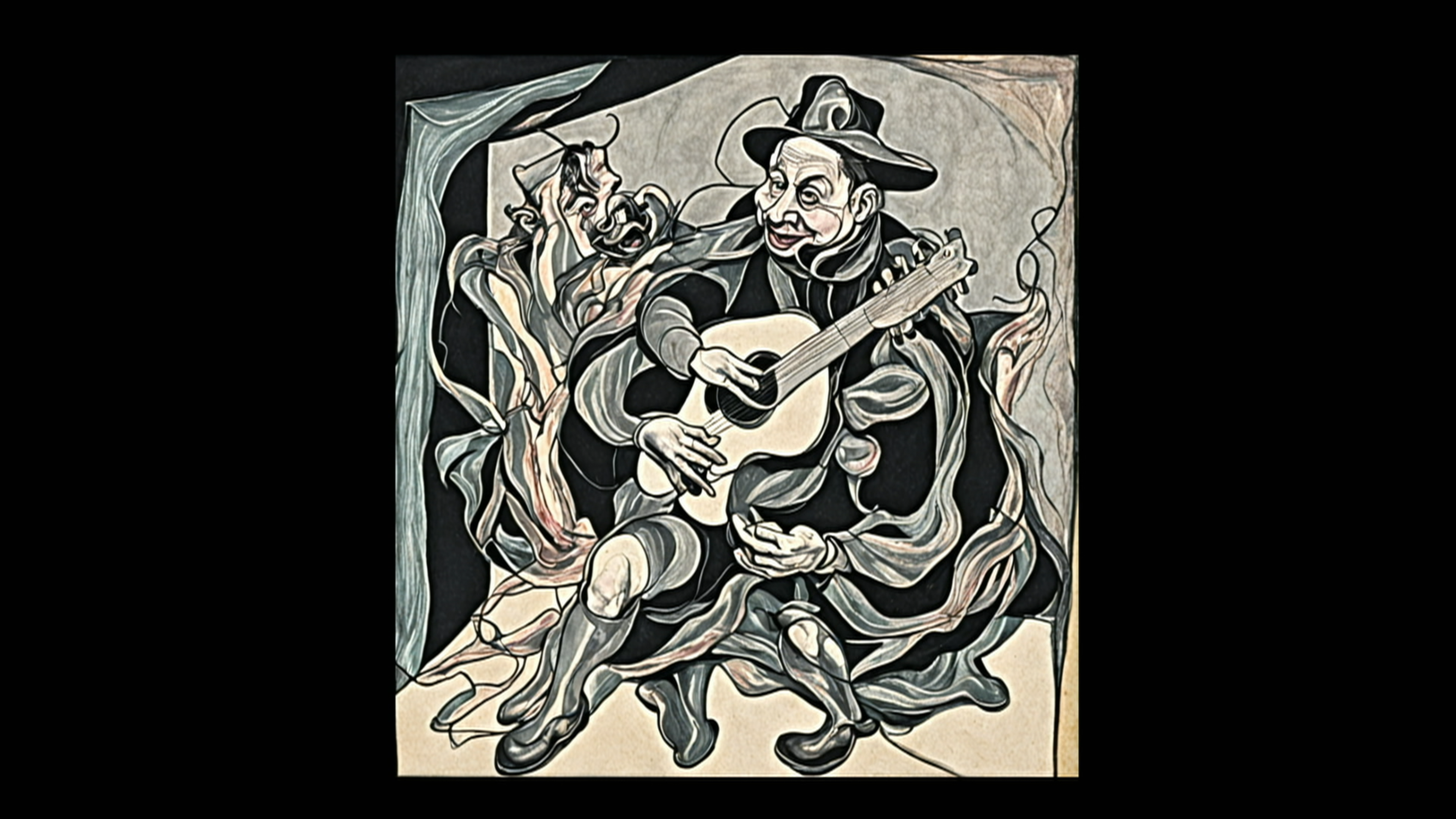
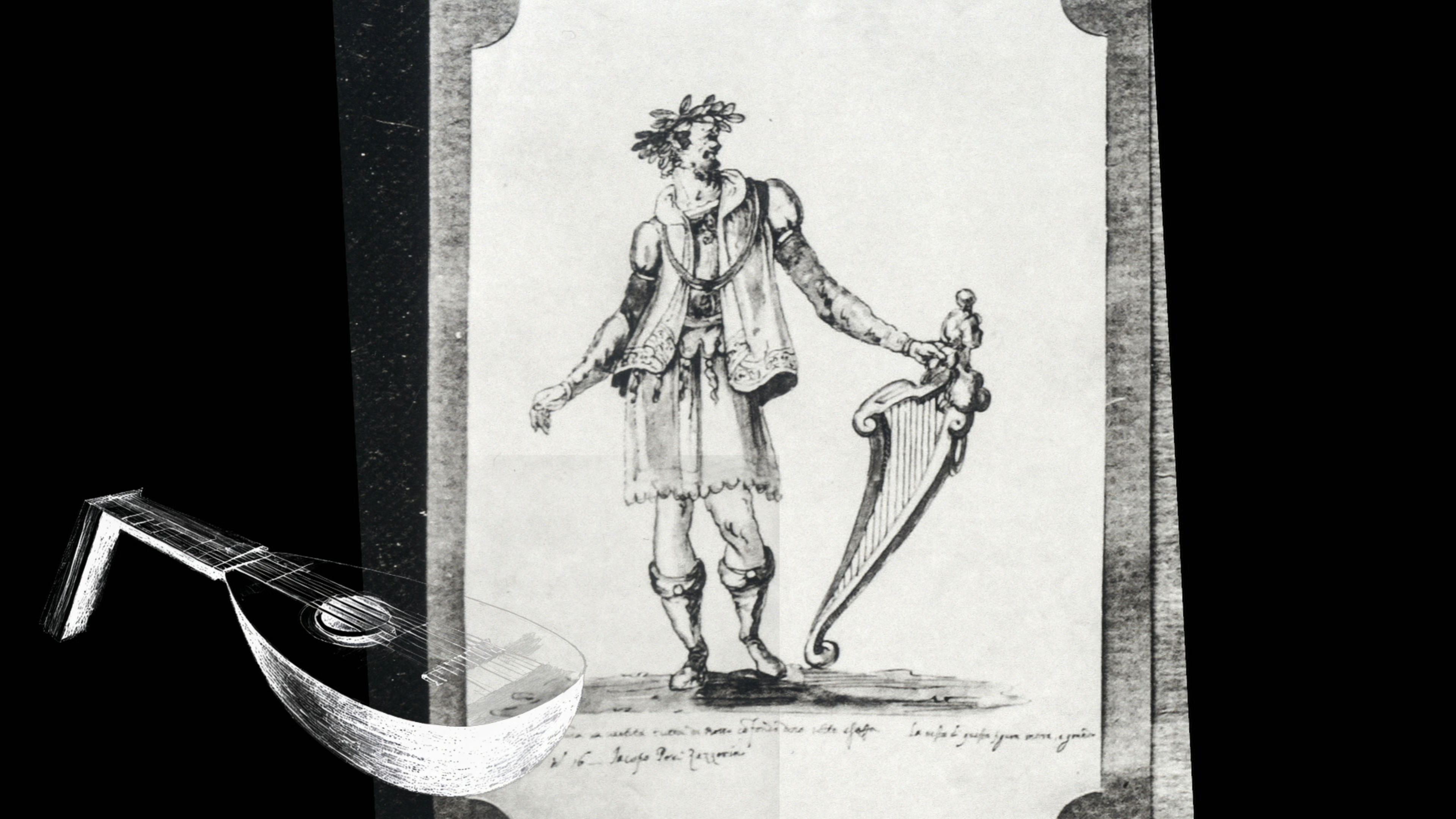
Pictures no. 2 and 3 of Panel 38 are about the relationship between the mixed style, book printing of the Renaissance and antiquity. In picture no. 2 the constellation refers to “cruelty of love,” in picture no. 3 ,to the grotesque, music and a specific instrument. In the latter case, 100 years after the printed books cited by Warburg, the connection of music to antiquity and thus to the emergence of opera takes place. This relationship has no historical or actual connection to antiquity, but rather a mental and material one. It is astonishing that in the “preliminary versions,” in the appendix of the picture atlas on Panel 60, Warburg constellates the composer Jacopo Peri, to whom we owe the first return to antiquity in the form of an opera. The subject of this opera is Ovid’s story of the persecution of the nymph Dafne (the small “f” written in Italian) by the greedy god Apollo. In his hands the young woman turns into wood. However, not into just any wood, but to the “laurel tree whose leaves do not wither.” Since that crime, according to Ovid, the laurel tree has populated the coasts of the Mediterranean. There is still a remnant of laurel on Caesar’s head at the moment he is murdered. This doesn’t save the dictator because laurel, created as a result of a rape attempt, doesn’t save anyone. Jacopo Peri also composed the festival opera on the occasion of the wedding of King Henri Quatre to Maria de Medici. All this took place a few years before the first opera by Claudio Monteverdi, Orfeo, was recorded in opera history.
Panel 38, Picture 2
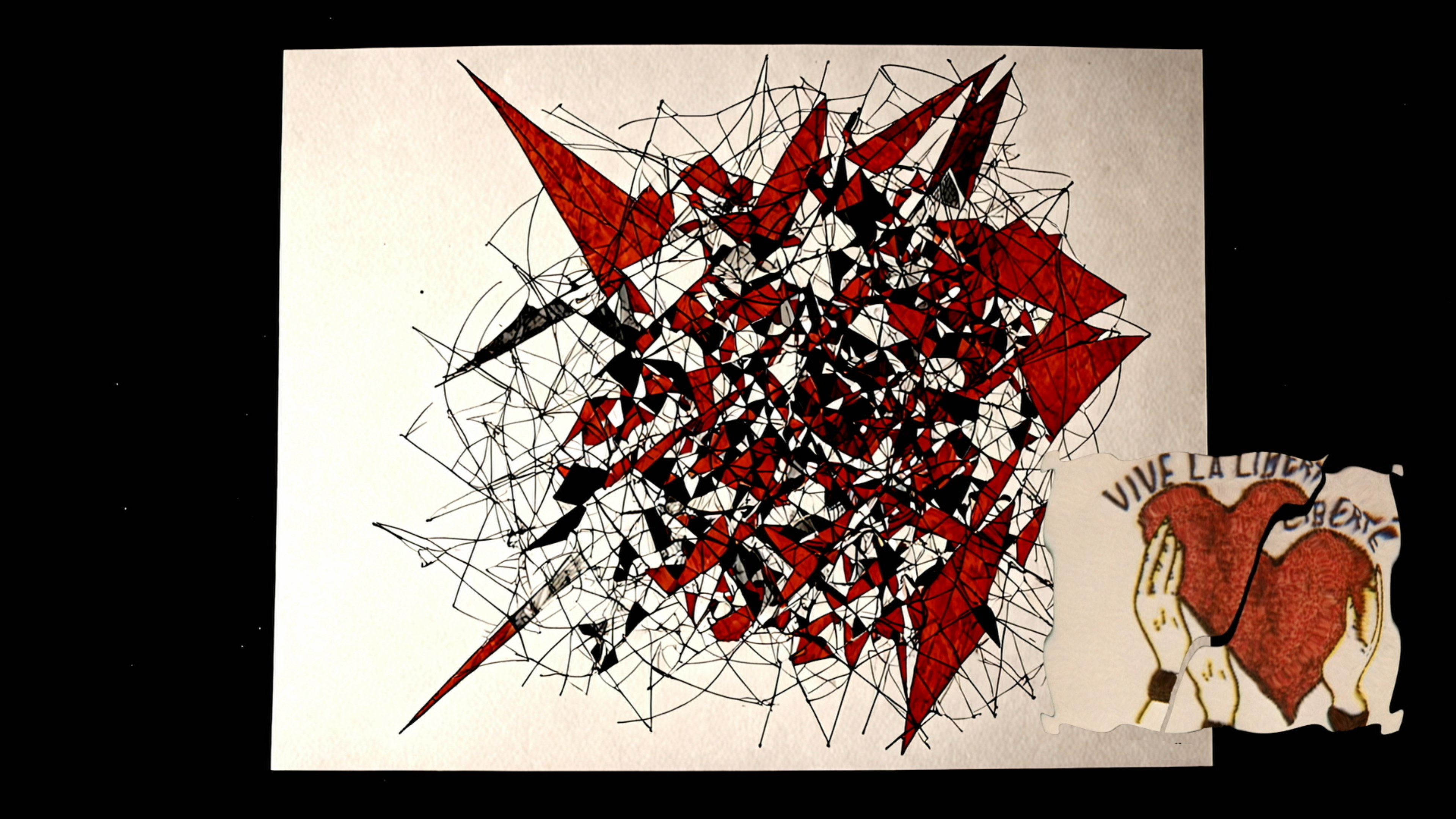
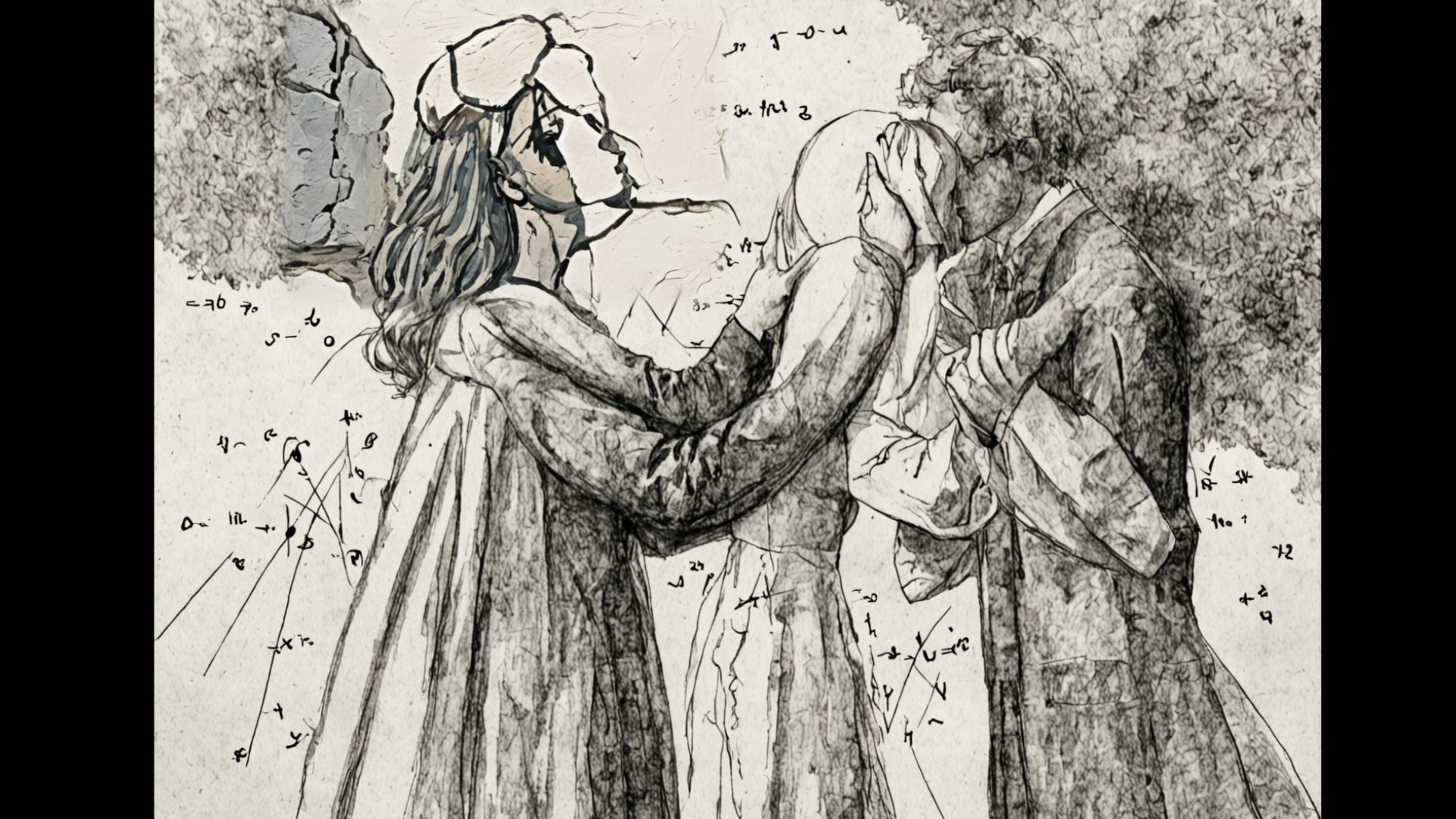
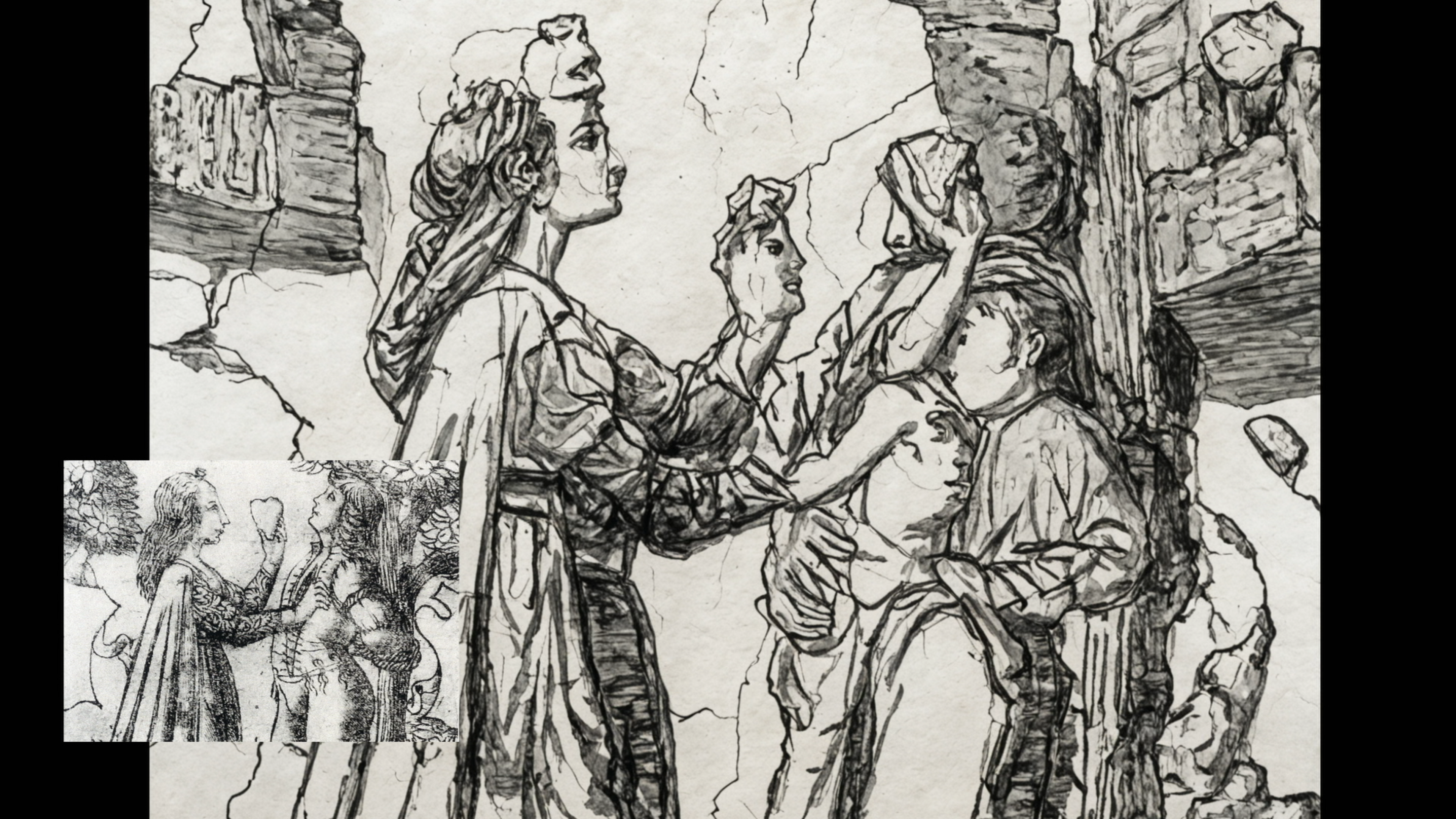
The Cruelty of Love / One of the so-called Otto Prints / 1465 – 1480 / Attributed to Baccio Baldini
Length 2:49 min.
A loving couple. The lover is tied to a tree. His chest is anatomically open. The lover has taken his heart out of his chest and is holding it in front of his eyes. Mannerist image that, to my knowledge, has no equivalent in antiquity.
Panel 38, Picture 3
Grotesque Bust of a Lute Player / one of the so-called Otto-Prints / 1465 – 1480 / Attributed to Baccio Baldini
Length 5:33 min.
- Luck / Fortune
- Collecting what remains of collapsed relationality in the modern world… / The form for this is called COMMENTARY
- Art History in its Longue Durée (Georges Didi-Huberman)
Alexander Kluge: Cultural History in Dialogue is a joint project of Cornell University, Universität Bremen and Princeton University.